Nursing Practice (DNP) - MSN to DNP for Advanced Practice Nursing Roles program and course guide
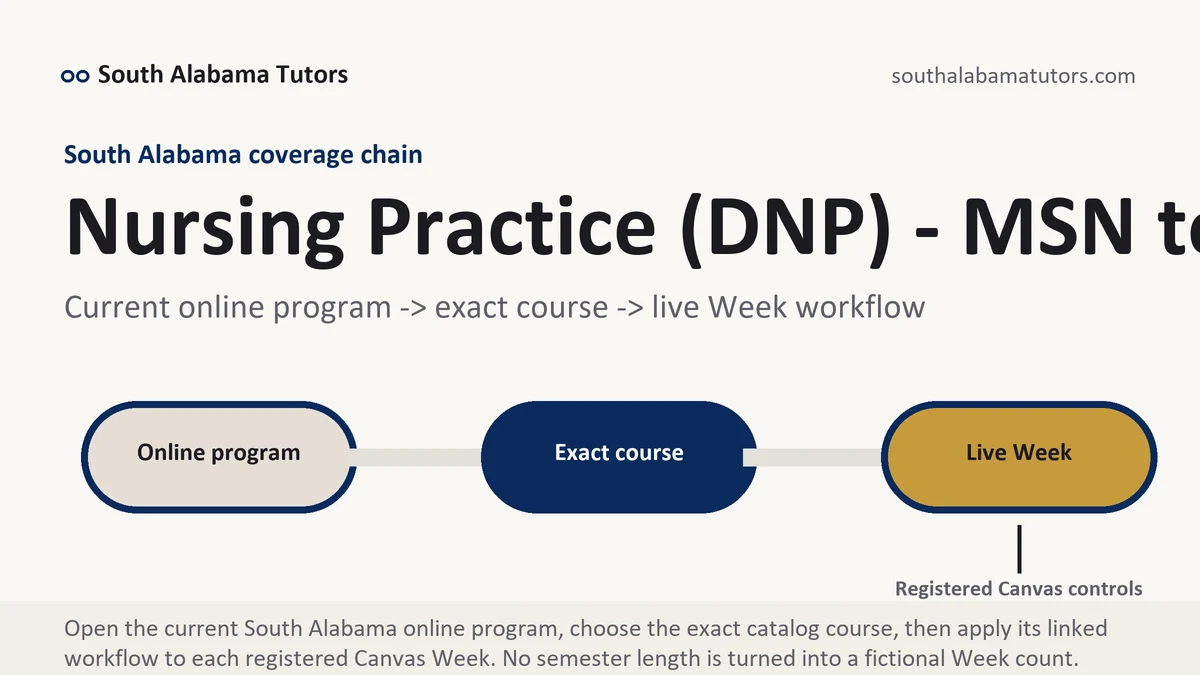
Start with the official program route, open the exact class, then use its Live Week workflow beside the registered USAonline course, syllabus, Canvas activity, and rubric.
Nursing Practice (DNP) - MSN to DNP for Advanced Practice Nursing Roles is included in South Alabama's current online-program scope. This page preserves every published curriculum row, including repeated option rows, without converting alternatives into requirements or promising that transfer and professional credit will apply to one student.
How to read this program map
Read the nursing curriculum as a set of pathway, core, concentration, subspecialty, evidence, leadership, informatics, population, and practice decisions rather than one universal sequence. Clinical and non-clinical options legitimately differ, and the student's admission pathway controls.
The headings below preserve the Bulletin's structure. Mark each row required, prerequisite, alternative, concentration, subspecialty, elective, transfer-complete, planned, registered, active, or complete. Use the student's governing catalog, official degree audit, transfer evaluation, admission letter, program handbook, and advisor decision to choose among published routes.
A repeated code can serve several programs or option tables without requiring repeated enrollment. Each code resolves to one canonical course guide. That course guide links back to every current program context and forward to one reusable Live Week workflow, keeping identity stable while the registered section supplies the actual work.
Current published curriculum
The tables follow the frozen current Bulletin page and preserve its course rows, headings, notes, alternatives, and exposed hours. A linked row provides navigation, not a claim that the course is required for every student. Flexible ranges and choice lists remain flexible; the public map never fills them with invented requirements.
DNP Core Courses
| Course or requirement | Published title or note | Hours | Coursework control |
|---|---|---|---|
| Code Title Hours | |||
| NU 607 | Scientif Underpinnings Adv Nsg | 3 | Live Week workflow |
| NU 608 | EBP & Quality Improvement HCS | 3 | Live Week workflow |
| NU 610 | Healthcare Policy & Finance | 3 | Live Week workflow |
| NU 611 | Translat Evidence Practice Sys | 3 | Live Week workflow |
| NU 612 | Clinical Prev Population Hlth | 3 | Live Week workflow |
| NU 613 | Organizational & Sys Leadrshp | 3 | Live Week workflow |
| NU 615 | Qual Improv & Outcomes Assmnt | 3 | Live Week workflow |
| NU 616 | Data & Dec Mkng Healthcare Sys | 3 | Live Week workflow |
| Total Hours 24 | 24 | ||
Adult-Gerontological Acute Care Nurse Practitioner
| Course or requirement | Published title or note | Hours | Coursework control |
|---|---|---|---|
| Code Title Hours | |||
| AHN 604 | Adult-Geron Acute Care NP PP&D | 3 | Live Week workflow |
| AHN 617 | AG ACNP Residency I | 3 | Live Week workflow |
| AHN 618 | AG ACNP Residency II | 3 | Live Week workflow |
| AHN 619 | AG ACNP Residency III | 3 | Live Week workflow |
| Total Hours 12 | 12 | ||
Adult-Gerontological Primary Care Nurse Practitioner
| Course or requirement | Published title or note | Hours | Coursework control |
|---|---|---|---|
| Code Title Hours | |||
| AHN 693 | Adult-Geron Primary NP PP&D | 3 | Live Week workflow |
| AHN 694 | Adult-Gero Primary Cr NP Res I | 3 | Live Week workflow |
| AHN 695 | Adlt-Gero Primary Cr NP Res II | 3 | Live Week workflow |
| AHN 696 | Adlt-Gero Prim Care NP Res III | 3 | Live Week workflow |
| Total Hours 12 | 12 | ||
Adult-Gerontological Clinical Nurse Specialist
| Course or requirement | Published title or note | Hours | Coursework control |
|---|---|---|---|
| Code Title Hours | |||
| AHN 634 | Adult-Geron CNS PP&D | 3 | Live Week workflow |
| AHN 635 | Adult-Geron CNS Residency I | 3 | Live Week workflow |
| AHN 636 | Adult-Geron CNS Residency II | 3 | Live Week workflow |
| AHN 637 | Adult-Geron CNS Residency III | 3 | Live Week workflow |
| Total Hours 12 | 12 | ||
Dual Role (Family NP/Adult-Gerontological Acute Care NP) Option: A) Family NP
| Course or requirement | Published title or note | Hours | Coursework control |
|---|---|---|---|
| Code Title Hours | |||
| AHN 680 | Family NP (DR) PP&D | 3 | Live Week workflow |
| AHN 681 | Family NP (DR) Residency I | 3 | Live Week workflow |
| AHN 682 | FNP (DR) Residency II | 3 | Live Week workflow |
| AHN 683 | FNP (DR) Residency III | 3 | Live Week workflow |
| Total Hours 12 | 12 | ||
Dual Role (Family NP/Adult-Gerontological Acute Care NP) Option B.) Adult-Gerontological Acute Care NP
| Course or requirement | Published title or note | Hours | Coursework control |
|---|---|---|---|
| Code Title Hours | |||
| AHN 670 | AG-ACNP(DR) PP&D | 3 | Live Week workflow |
| AHN 671 | AG/ACNP (DR) Residency I | 3 | Live Week workflow |
| AHN 672 | AG-ACNP (DR) Residency II | 3 | Live Week workflow |
| AHN 673 | AG-ACNP(DR) Residency III | 3 | Live Week workflow |
| Total Hours 12 | 12 | ||
Dual Role (Family NP/Emergency NP)
| Course or requirement | Published title or note | Hours | Coursework control |
|---|---|---|---|
| Code Title Hours | |||
| NU 680 | Family/Emergency NP PP&D | 3 | Live Week workflow |
| NU 681 | Family/Emerg NP Residency I | 3 | Live Week workflow |
| NU 682 | Family/Emerg NP Residency II | 3 | Live Week workflow |
| NU 683 | Family/Emerg NP Residency III | 3 | Live Week workflow |
| Total Hours 12 | 12 | ||
Executive Nursing Administration
| Course or requirement | Published title or note | Hours | Coursework control |
|---|---|---|---|
| Code Title Hours | |||
| NU 661 | Executive Nsg Admin PP&D | 3 | Live Week workflow |
| NU 662 | Nurse Exec Admin Res I | 3-6 | Live Week workflow |
| NU 663 | Nurse Exec Admin Res II | 3-6 | Live Week workflow |
| NU 664 | Nurse Exec Admin Res III | 3-6 | Live Week workflow |
| Total Hours 12-21 | 12-21 | ||
Family Nurse Practitioner
| Course or requirement | Published title or note | Hours | Coursework control |
|---|---|---|---|
| Code Title Hours | |||
| CMN 680 | Family NP PP&D | 3 | Live Week workflow |
| CMN 681 | Family NP Residency I | 3 | Live Week workflow |
| CMN 682 | Family NP Residency II | 3 | Live Week workflow |
| CMN 683 | Family NP Residency III | 3 | Live Week workflow |
| Total Hours 12 | 12 | ||
Neonatal Nurse Practitioner
| Course or requirement | Published title or note | Hours | Coursework control |
|---|---|---|---|
| Code Title Hours | |||
| MCN 674 | Neonatal NP PP&D | 3 | Live Week workflow |
| MCN 675 | NNP Residency I | 3 | Live Week workflow |
| MCN 676 | NNP Residency II | 3 | Live Week workflow |
| MCN 677 | NNP Residency III | 3 | Live Week workflow |
| Total Hours 12 | 12 | ||
Nursing Informatics
| Course or requirement | Published title or note | Hours | Coursework control |
|---|---|---|---|
| Code Title Hours | |||
| NU 656 | Nursing Informatics PP&D | 3 | Live Week workflow |
| NU 657 | Nursing Informatic Residency I | 3-6 | Live Week workflow |
| NU 658 | NU Informatics Residency II | 3-6 | Live Week workflow |
| NU 659 | NU Informatics Residency III | 3-6 | Live Week workflow |
| Total Hours 12-21 | 12-21 | ||
Pediatric Acute Care Nurse Practitioner
| Course or requirement | Published title or note | Hours | Coursework control |
|---|---|---|---|
| Code Title Hours | |||
| MCN 604 | Pediatric Acute Care NP PP&D | 3 | Live Week workflow |
| MCN 617 | Pediatric Acute Care NP Res I | 3 | Live Week workflow |
| MCN 618 | Pediatric Acute Care NP Res II | 3 | Live Week workflow |
| MCN 619 | Pediatric Acute Cre NP Res III | 3 | Live Week workflow |
| Total Hours 12 | 12 | ||
Pediatric Primary Care Nurse Practitioner
| Course or requirement | Published title or note | Hours | Coursework control |
|---|---|---|---|
| Code Title Hours | |||
| MCN 654 | Pediatric Primary Care NP PP&D | 3 | Live Week workflow |
| MCN 655 | Ped Prim Care NP Residency I | 3 | Live Week workflow |
| MCN 656 | Ped Primary Care NP Res II | 3 | Live Week workflow |
| MCN 657 | Ped Primary Care NP Res III | 3 | Live Week workflow |
| Total Hours 12 | 12 | ||
Psychiatric Mental Health Nurse Practitioner
| Course or requirement | Published title or note | Hours | Coursework control |
|---|---|---|---|
| Code Title Hours | |||
| CMN 604 | PMHNP PP&D | 3 | Live Week workflow |
| CMN 617 | PMHNP Residency I | 3 | Live Week workflow |
| CMN 618 | PMHNP Residency II | 3 | Live Week workflow |
| CMN 619 | PMHNP Residency III | 3 | Live Week workflow |
| Total Hours 12 | 12 | ||
Women's Health Nurse Practitioner
| Course or requirement | Published title or note | Hours | Coursework control |
|---|---|---|---|
| Code Title Hours | |||
| MCN 644 | Women's Health NP PP&D | 3 | Live Week workflow |
| MCN 645 | Women's Health NP Residency I | 3 | Live Week workflow |
| MCN 646 | Women's Health NP Residency II | 3 | Live Week workflow |
| MCN 647 | Women's Health NP Res III | 3 | Live Week workflow |
| Total Hours 12 | 12 | ||
Addictions Nursing
| Course or requirement | Published title or note | Hours | Coursework control |
|---|---|---|---|
| Code Title Hours | |||
| HSC 580 | OUD/SUD Prevention/Screening | 2 | Live Week workflow |
| HSC 581 | OUD/SUD Assessment/Treatment | 2 | Live Week workflow |
| HSC 582 | OUD/SUD Recovery/Sys Practice | 2 | Live Week workflow |
| NU 510 | Addictions Practicum I | 1 | Live Week workflow |
| NU 511 | Addictions Practicum II | 2 | Live Week workflow |
| NU 512 | Addictions Practicum III | 2 | Live Week workflow |
| NU 513 | Addictions Practicum IV (Elective) | 4 | Live Week workflow |
| Total Hours 15 | 15 | ||
Advanced Forensic Nursing
| Course or requirement | Published title or note | Hours | Coursework control |
|---|---|---|---|
| Code Title Hours | |||
| NU 500 | Explore Culture Sexual Assault | 2 | Live Week workflow |
| NU 503 | Trauma Care Sexual Assault Vic | 2 | Live Week workflow |
| NU 504 | Adv Pharm Care Post Assault | 2 | Live Week workflow |
| NU 505 | Sup Care Comorbid Post Assault | 2 | Live Week workflow |
| Total Hours 8 | 8 | ||
Cardiovascular
| Course or requirement | Published title or note | Hours | Coursework control |
|---|---|---|---|
| Code Title Hours | |||
| HSC 520 | Foundations of Cardiovascular Care for Advanced Practice | 2 | Live Week workflow |
| HSC 521 | Advanced Cardiovascular Concepts I | 2 | Live Week workflow |
| HSC 522 | Advanced Cardiovascular Concepts II | 2 | Live Week workflow |
| HSC 523 | Advanced Cardiovascular Concepts III | 2 | Live Week workflow |
| Total Hours 8 | 8 | ||
Clinical Lipidology
| Course or requirement | Published title or note | Hours | Coursework control |
|---|---|---|---|
| Code Title Hours | |||
| HSC 595 | Evidence Basd Lipid Practice | 2 | Live Week workflow |
| HSC 596 | Adv Vascular Biology | 2 | Live Week workflow |
| HSC 597 | Adv Pharm Complex Dyslipidemia | 2 | Live Week workflow |
| HSC 598 | Diag/Mgt C-plex Dyslipidemia | 2 | Live Week workflow |
| Total Hours 8 | 8 | ||
Nurse Educator
| Course or requirement | Published title or note | Hours | Coursework control |
|---|---|---|---|
| Code Title Hours | |||
| NU 620 | Prin Teach/Learn/Assess Nu Ed | 3 | Live Week workflow |
| NU 621 | Curr Design/Outcome Eval Nu Ed | 3 | Live Week workflow |
| NU 622 | Current Topics in Nu Education | 2 | Live Week workflow |
| NU 623 | Nsg Educ Synthesis Practicum | 3 | Live Week workflow |
| Total Hours 11 | 11 | ||
Palliative Care
| Course or requirement | Published title or note | Hours | Coursework control |
|---|---|---|---|
| Code Title Hours | |||
| AHN 530 | Found Palliative Care/Adv Role | 2 | Live Week workflow |
| AHN 531 | Adv Palliative Cr/End of Life | 2 | Live Week workflow |
| AHN 532 | Adv Chronic Illness Care | 2 | Live Week workflow |
| AHN 533 | Adv Palliative Care Practicum | 3 | Live Week workflow |
| Total Hours 9 | 9 | ||
Social Determinants of Health and Health Disparities
Trauma-Informed Integrated Behavioral Healthcare
| Course or requirement | Published title or note | Hours | Coursework control |
|---|---|---|---|
| Code Title Hours | |||
| HSC 510 | IPT for TI-IBH Primary Care | 1 | Live Week workflow |
| HSC 511 | IPT Telehealth Deliv TI-IBH | 1 | Live Week workflow |
| HSC 512 | TI-MI in IBH Seminar | 1 | Live Week workflow |
| NU 526 | Trauma-Informed Integrated Behavioral Healthcare Practicum I | 1 | Live Week workflow |
| NU 527 | Trauma-Informed Integrated Behavioral Healthcare Practicum II | 2 | Live Week workflow |
| NU 528 | Trauma-Informed Integrated Behavioral Healthcare Practicum III | 2 | Live Week workflow |
| Total Hours 8 | 8 | ||
Elective Courses
| Course or requirement | Published title or note | Hours | Coursework control |
|---|---|---|---|
| Code Title Hours | |||
| NU 509 | Bioethics Advan Practice Nsg | 1 | Live Week workflow |
| NU 597 | Intro to Scholarly Writing | 3 | Live Week workflow |
| HSC 573 | Resp Prescrib Common Used Drug | 1 | Live Week workflow |
Build the student's controlled sequence
Create a planner with program, pathway or concentration, requirement group, course code, title, hours, prerequisite, co-requisite, admission gate, transfer decision, planned term, delivery method, registration status, and completion evidence. Put alternatives in a decision column rather than scheduling all of them. Ask South Alabama to confirm substitutions, overlaps, residency, repeat, transfer, license, and age-of-credit assumptions before removing any published requirement.
Track non-course dependencies on the same page: orientation, background or health clearance, professional license, clinical site, practice agreement, preceptor, simulation, laboratory, research approval, group meeting, live presentation, testing arrangement, technology, graduation application, and state authorization when applicable. Being current in Canvas does not prove that an external progression gate is complete.
From the class to its real coursework
South Alabama's public Bulletin verifies course codes, titles, credits, descriptions, and prerequisites. It does not expose a dependable section-by-section list of numbered Weeks. For that reason every course links to exactly one Live Week workflow. The workflow is reused whenever new work opens and never pretends that a semester length equals an assignment count.
At the opening of a real Canvas week, capture the syllabus language, module or week title, learning objectives, assigned readings and media, discussion and reply duties, written or quantitative task, quiz or examination controls, project milestone, laboratory or clinical dependency, rubric criteria, point value, due date and time zone, permitted resources, file type, and submission route. Current announcements and instructor clarifications belong in the same control record.
Keep evidence, calculations, and feedback cumulative
Maintain an evidence ledger across the program with course, live activity, rubric criterion, question or decision, source, authority or study design, date, population or setting, useful finding, limitation, and intended use. Assigned sources remain visibly assigned. Professional examples must be lawful, authorized, and de-identified; patient, client, employer, employee, peer, and research-participant details do not leave approved systems.
Quantitative work needs a parallel calculation record containing source values, units, period, formula or analytical rule, transformations, intermediate results, output, reasonableness check, and interpretation. Feedback needs criterion, instructor comment, diagnosed cause, correction, and a concrete rule for the next activity. Carry forward methods and lessons, not previously submitted wording.
Use syllabus, Canvas, and rubric as three controls
The syllabus establishes course-level outcomes, grading structure, policies, materials, major dates, and instructor expectations. Canvas supplies the registered activity, current resources, announcements, gradebook state, and submission route. The rubric converts the present deliverable into observable criteria and performance levels. Compare all three before beginning and again before submission.
If dates, point values, formats, or instructions conflict, preserve screenshots or text from the official locations and ask the instructor through the approved channel. An old syllabus, another section, a search result, a public tutoring page, or a model paper cannot overrule the registered classroom. Update the planner only after an official clarification.
Responsible tutoring in this program
A tutor may explain a concept, model a method on parallel material, create original practice, help the student interpret instructions, plan research, organize a study schedule, ask diagnostic questions, and critique student-authored work. Useful feedback points to the live rubric, explains why a reasoning step succeeds or fails, and leaves the student able to reconstruct and defend the work independently.
Clinical placement, patient contact, simulation, laboratory work, practice hours, preceptor interaction, competency demonstration, proctored testing, licensure activity, identity checks, and official documentation are completed and verified by the student through South Alabama's approved processes.
A tutor does not request school credentials, enter Canvas, impersonate the student, author a submission, post a discussion or reply, take a quiz or examination, operate equipment, provide patient care, fabricate data or sources, invent an encounter, perform research or group participation, log hours, sign forms, contact South Alabama as the student, or press submit. The student authors, personalizes, verifies, participates, and submits.
Program-level quality gate
Before registration, reconcile the governing catalog, official audit, program route, prerequisites, co-requisites, transfer evaluation, delivery method, term, and non-course dependencies. Before each activity, reconcile the syllabus, current Canvas instructions, rubric, resources, dates, points, permitted tools, participation duties, confidentiality, and student-only controls. Before submission, test completeness, evidence, calculations, citations, format, accessibility, authorship, file integrity, and the submission route.
Before closing a course, open the gradebook, verify every expected activity and submission receipt, capture instructor feedback, and resolve missing or incorrect states through official channels. Before graduation, reconcile every academic, administrative, clinical, professional, financial, and application gate with South Alabama. A public curriculum map is a navigation aid, not an institutional clearance.
Source control
This page uses the current Bulletin entry for Nursing Practice (DNP) - MSN to DNP for Advanced Practice Nursing Roles and the applicable South Alabama Online Programs directory, checked July 30, 2026. It records public program identity, headings, notes, course rows, titles, and exposed hours. The governing catalog, official audit, transfer and admission decisions, registered syllabus, USAonline and Canvas course, rubric, announcements, instructor directions, handbooks, schedules, and policies remain controlling.
Program questions
Is Nursing Practice (DNP) - MSN to DNP for Advanced Practice Nursing Roles a current South Alabama online program?
Yes. Its identity is present in South Alabama's current Online Programs directory and its curriculum rows come from the current Bulletin, checked July 30, 2026. The student's governing catalog and official audit control.
Does every row in every option apply to one student?
No. The map preserves cores, pathways, concentrations, subspecialties, alternatives, notes, and electives. The official degree audit, admissions decision, transfer evaluation, and advisor identify the student's route.
Why does every course link to one Live Week workflow?
South Alabama's public catalog verifies course identity but does not publish section-level Week identities. The reusable workflow begins by capturing the registered Canvas week, syllabus, activity, and rubric.
What must the student personally complete?
The student completes all authorship, discussions, replies, examinations, calculations, clinical and professional activity, research, collaboration, presentations, identity checks, verification, and submission.